.png)
ACL Surgery Recovery: ACL Repair vs. Reconstruction
An ACL injury can be a frustrating one. Whether it happens on the soccer field, while skiing, during a game of basketball, or from an awkward change of direction, an ACL tear can significantly affect how stable and confident your knee feels.
The good news? ACL injuries are very treatable, and with the right combination of surgical care and rehabilitation, many people are able to return to the activities they enjoy.
One thing that can be confusing when researching an ACL injury is the difference between an ACL repair and an ACL reconstruction. Although the terms are sometimes used interchangeably, they are actually two different procedures — and the ideal candidate and recovery process can be somewhat different.
ACL Repair vs. ACL Reconstruction: What's the Difference?
An ACL reconstruction involves removing the torn ACL and replacing it with a graft. The graft may come from your own tissue, such as the patellar tendon or hamstring tendon, or from donor tissue.
An ACL repair, on the other hand, attempts to preserve your original ACL. The surgeon reattaches the torn ligament to its attachment site and may use sutures or other forms of reinforcement to support the healing process.
This means that not every ACL tear is suitable for repair. The location and quality of the remaining ligament tissue are important factors.
In general, tears where the ACL has pulled away from its attachment on the femur, while leaving good-quality ligament tissue behind, may be more suitable for repair. Tears through the middle of the ligament (midsubstance tears) are generally less suitable for repair.
So, while both procedures are designed to restore stability to the knee, they are not interchangeable surgeries.
Is the recovery faster after an ACL repair?
This is where things get a little more complicated. Because an ACL repair preserves the person's own ligament, there is less donor tissue involved and potentially less disruption to the surrounding tissues. Some people may therefore have a somewhat easier early recovery following repair.
However, that doesn't necessarily mean you'll be back to sport months earlier. The ACL still needs time to heal, and the knee still needs to regain strength, movement control and confidence. The rehabilitation process following either surgery is a significant commitment.
The exact timeline depends on the surgical technique, the type of tear, any additional injuries and the individual's progress.
The important takeaway: ACL repair may offer some advantages in the early recovery period for appropriate patients, but it should not be thought of as a "quick fix" compared with reconstruction.
1. What Is an ACL Tear?
The anterior cruciate ligament (ACL) is one of the major ligaments inside the knee. It runs through the middle of the joint, connecting the femur (thigh bone) to the tibia (shin bone). The ACL helps control forward movement and rotation of the shin bone and plays an important role in keeping the knee stable during movement.
An ACL tear most commonly occurs with a sudden change in direction, pivot, jump, landing or deceleration. It can happen without any contact from another person, although contact injuries can also cause an ACL tear.
Because the ACL is particularly important for controlling rotational and forward movement, people may notice that their knee feels relatively comfortable during everyday activities but becomes unstable when they try to run, jump, pivot or change direction.
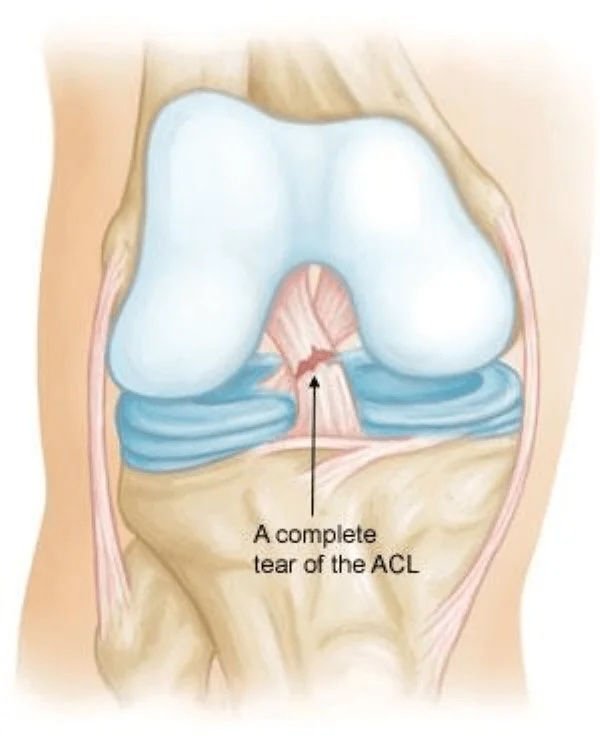
Some common signs of an ACL injury include:
A popping sensation at the time of injury
Rapid swelling of the knee
Difficulty fully straightening or bending the knee
Pain with walking or weight-bearing
A feeling that the knee is unstable or "giving way"
Difficulty returning to cutting, pivoting or jumping activities
The ACL is made up of strong connective tissue and works together with the other ligaments, muscles and structures of the knee to provide stability. This is why recovering from an ACL injury involves more than simply allowing the ligament to heal — rehabilitation also focuses on rebuilding the strength, coordination and control needed to keep the knee stable during movement.
An MRI is often used alongside a clinical assessment to confirm the diagnosis and identify any additional injuries, such as damage to the meniscus, cartilage or other ligaments in the knee. These associated injuries can also influence the treatment approach and rehabilitation timeline.
2. What are the treatment options for an ACL tear?
Not every ACL tear requires surgery.
Treatment generally falls into two categories: non-operative rehabilitation and surgical treatment.
For some people, physiotherapy and activity modification can provide enough strength, stability and confidence to return to their desired activities without surgery. This may be particularly appropriate for people who don't participate in sports involving frequent cutting and pivoting.
Surgical treatment may involve either ACL reconstruction or, in carefully selected cases, ACL repair. The decision should be based on more than just the MRI. Your activity goals, symptoms, knee stability, associated injuries and the specific characteristics of your tear all need to be considered.
3. Who is a good candidate for ACL surgery?
Surgery may be considered when:
The knee continues to feel unstable despite rehabilitation
You want to return to sports involving pivoting, cutting or rapid changes in direction
Your work requires significant physical activity
There are associated meniscus or cartilage injuries
You have a tear pattern that is appropriate for surgical treatment
You've discussed the risks, benefits and rehabilitation commitment with your surgeon and physiotherapist
For ACL repair specifically, the location and quality of the torn ligament are particularly important. Someone with a tear near the femoral attachment and good-quality remaining ACL tissue may be considered for repair, whereas someone with a midsubstance tear may be more likely to require reconstruction.
Ultimately, your orthopedic surgeon will determine whether the ligament is suitable for repair.
4. What is the healing timeline after ACL surgery?
Whether you've had an ACL repair or reconstruction, surgery is only the beginning of the process. The early stages of rehabilitation following both procedures can look quite similar. The priorities are to control swelling, restore movement, activate the quadriceps and gradually return to normal walking.
Where the timelines can differ is in the specifics of the surgical procedure and the restrictions placed on the knee during the early stages.
For an uncomplicated ACL surgery, a general timeline may look like this:

Weeks 0–2: Protect and restore movement
The initial focus is on:
Controlling pain and swelling
Restoring full knee extension
Gradually restoring knee flexion
Activating the quadriceps
Regaining a normal walking pattern
Beginning appropriate weight-bearing and mobility exercises
Your surgeon may provide specific restrictions depending on the type of surgery performed.
Weeks 2–6: Restore function and build a foundation
As swelling decreases and movement improves, rehabilitation progresses toward:
Normal walking
Increasing knee range of motion
Progressive strengthening
Improving balance
Building quadriceps, hamstring and glute strength
If you've had additional procedures, such as a meniscus repair, your restrictions may be different.

Weeks 6–12: Progressive strengthening
This is where rehabilitation starts to become much more exercise-focused.
The goal is to progressively challenge the muscles around the knee and improve single-leg strength and control.
Exercises may include:
Squats
Split squats
Step-ups and step-downs
Lunges
Leg press
Hamstring strengthening
Single-leg exercises
Balance and proprioceptive work
The goal isn't simply to make the knee feel good. We want to build a knee that is strong enough to handle progressively greater loads.
3–6 months: Running, jumping and dynamic movement
Once appropriate strength, range of motion and movement control have been achieved, rehabilitation can progress toward more dynamic activities.
This may include:
Running
Jumping and landing
Acceleration and deceleration
Hopping
Agility work
More demanding single-leg exercises
The timing of running and jumping should be based on your individual progress rather than simply reaching a certain date on the calendar.

6–12+ months: Return to sport
The final phase focuses on preparing the knee for the specific demands of your sport or activity.
This might include:
Cutting and pivoting
Change-of-direction drills
Sport-specific movements
Reactive agility
Higher-level jumping and landing
Return-to-sport testing
For athletes, returning to sport is ideally based on a combination of time, strength, movement quality, functional testing and psychological readiness.
So, is ACL repair recovery actually faster than reconstruction?
Potentially — but it's not as simple as saying "repair = six months and reconstruction = one year."
With a repair, the person's original ACL is preserved rather than replaced with a graft. This can potentially allow for a less invasive procedure and may provide some early recovery advantages in appropriately selected patients.
However, the ACL still needs to biologically heal, and rehabilitation still needs to progress through the same major stages: restoring movement, rebuilding strength, developing control, running, jumping and eventually returning to higher-level activity.
Some research suggests that appropriately selected ACL repair patients may have favourable early outcomes, but there is also concern about a higher risk of needing another surgery compared with reconstruction in some patient groups. Current AAOS guidance continues to recommend reconstruction over repair when surgery is indicated for acute isolated ACL tears, although repair may be considered in select tear patterns and patients.
The surgical technique matters, but so does the individual knee. Someone with an uncomplicated repair may progress differently from someone who has a reconstruction combined with a meniscus repair or cartilage procedure.
5. What does ACL rehabilitation actually look like?
Although everyone's program will look slightly different, ACL rehabilitation generally progresses through several stages:
Protect → Restore movement → Build strength → Develop control → Run and jump → Return to sport
One of the biggest mistakes we can make is thinking that once the knee stops hurting, rehabilitation is finished.
Pain and swelling are important markers, but they don't tell the whole story. Someone can feel quite good walking around day-to-day while still having significant deficits in quadriceps strength, single-leg control or confidence with higher-level movement.
That's why rehabilitation becomes increasingly challenging as you progress. Your physiotherapist will gradually increase the demands placed on the knee so that you're prepared for the activities you actually want to return to.
6. What are the expected outcomes after ACL surgery?
The goal of ACL surgery is to restore knee stability and allow you to return to your desired activities.
Many people experience significant improvements in pain, function, stability and confidence following appropriate treatment and rehabilitation.
However, an ACL surgery doesn't automatically mean you'll be back to your sport in six months. Returning to sport is a process, not a date.
Your physiotherapist and surgical team will consider things such as:
Knee range of motion
Swelling and symptoms
Quadriceps and hamstring strength
Single-leg strength
Jumping and landing mechanics
Agility and change-of-direction ability
Functional testing
Confidence in the knee
The demands of your specific sport
For someone returning to recreational hiking, the requirements will be very different from someone returning to competitive soccer or basketball.
The ultimate goal isn't simply to get you to a certain point on a rehabilitation timeline. It's to help you build a knee — and a body — that is prepared for what you want to do.
The Bottom Line
An ACL tear can feel like a major setback, but it doesn't have to mean giving up all your activities.
Some people can successfully manage an ACL tear without surgery, while others may benefit from surgical treatment. For those who require surgery, ACL repair and ACL reconstruction are two different procedures, and not every tear is suitable for repair.
Regardless of which procedure is performed, rehabilitation plays a huge role in the outcome. The process takes time, and there will likely be periods where progress feels slow. But with progressive strengthening, appropriate loading and a gradual return to running, jumping and sport-specific activity, the goal is to build back a knee that is strong, stable and ready for the demands of your life.
Comments